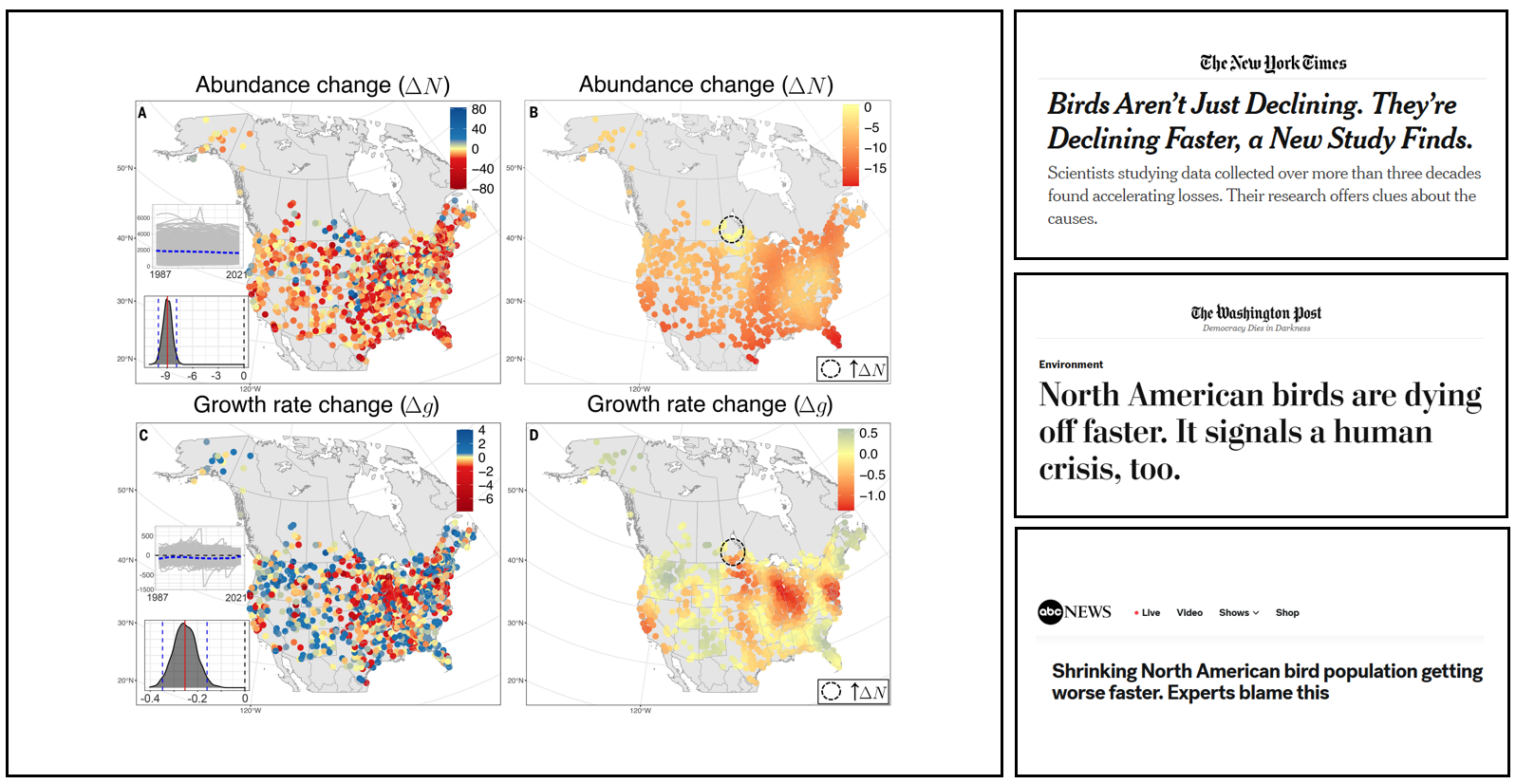
Francois and Petr, together with Marta Jarzyna from Ohio State University published a new paper in Science.
Using 1033 North American Breeding Bird Survey routes, we analyzed abundance change and its acceleration for 261 bird species, 54 avian families, and 10 habitats from 1987 to 2021. We show an average continent-wide decline of abundance of all birds per local route, with hotspots of decline in southern and warm parts of North America and hotspots of accelerating decline in the Mid-Atlantic, Midwest, and California, matching patterns of agricultural intensity. In contrast to the acceleration, the decline itself is more associated with patterns of temperature.
These are the most important novelties which brought the paper all the way to Science:
- We focus on acceleration, a shift from the traditional focus on simple declines or increases.
- We use cutting edge Bayesian models which account for imperfect detection, and we propagate the uncertainty of our estimates to as many steps of the analyses as possible.
- We were surprised to discover the signal of agriculture in the acceleration, but not in the decline itself. The latter seems to be more affected by temperature. In hindsight, however, the negative effect of agriculture seems plausible. This also shows that different aspects of temporal dynamics (e.g. decline vs its acceleration) can have different drivers.
- We offer a conceptual framework to study change of other phenomena. We suggest that ecologists should focus more on second derivations (acceleration or deceleration).
The article was also reported by New York Times, Washington Post or Associated Press among many outlets.