Abstract
Aim: Spatial autocorrelation (SAC), also known as aggregation or clumping, reflects species niche and dispersal, has conservation significance, and affects ecological models. Yet, we know little about the spatial and temporal patterns of SAC in empirical data. Here, we quantify the magnitude, spatial scaling, and temporal change of SAC in both species distributions and richness across multiple regions.
Location: Czechia, Europe, New York State, Japan.
Time Period: 1972–2017.
Major Taxa Studied: Birds.
Methods: We analysed four temporally replicated bird atlases, each aggregated to multiple spatial grains. We used Moran’s I to quantify the SAC of richness and the Join count statistic (JC) for species distributions. We assessed changes in SAC across time and spatial scales, the relationship between temporal changes in SAC and occupancy, and whether habitat association, trophic level, or dispersal ability influenced temporal SAC dynamics.
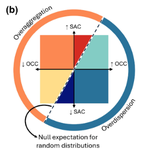
Results: Species distributions and diversity consistently showed positive SAC across all regions, periods, and grain sizes, with its magnitude declining at coarser grains. SAC showed no overall temporal trend, despite varying responses across species. However, joint temporal changes in JC and occupancy revealed systematic patterns: declining species became more aggregated (clumped) while expanding species became more fragmented (disjoint) than expected from occupancy change alone. Trait effects were overall weak—dispersal ability showed no influence, whereas the ranges of open-habitat species in Japan and herbivores in Japan and Europe became slightly more fragmented than expected.
Main Conclusions: Stronger SAC at finer grains suggests greater predictability of diversity and distributions at these scales. Despite zero average change in occupancy or SAC, their coupled shifts highlight the importance of considering both jointly. We found that non-adjacent colonisations and extirpations are major drivers of range dynamics in temperate birds. The limited role of traits suggests that extrinsic environmental and spatial factors dominate large-scale SAC dynamics.